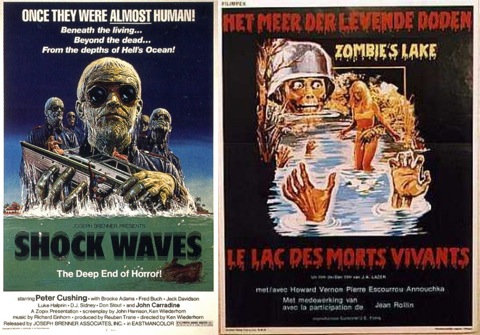
The last few weeks have been a bit eventful, to be sure. Since my return from Australia, I’ve gotten engaged, finished writing and editing my PhD thesis, and started developing iPhone applications. But my real accomplishment is this: I’ve managed to catch up to what are, to my knowledge, the only two Underwater Nazi Zombie movies ever made.
From the USA, weighing in at a lean 85 minutes, is 1977s Shock Waves. Directed by Ken “Meatballs Part II” Wiederhorn, this is the story of a shipwrecked yachting party, beached on a isolated island after colliding with a mysterious freighter. (So mysterious, in fact, that I don’t think its appearance is ever actually explained.) On the island they find an aging SS commander hiding out in an old hotel with a squad of Underwater Nazi Zombies. PG-13 chaos and carnage ensue.
And over here, from France, weighing in at 71 minutes, or 83 minutes, or 88 minutes, or 90 minutes–depending on your country’s censorship board’s tolerance for nude French women and seeing mannequins get lit on fire–is Zombie Lake. Made by prolific schlockmeister Jean Rollin in 1981 for literally tens of francs, this makes Shock Waves‘ low-budget aesthetic look lush. Zombie Lake quickly jettisons mood, tension, excitement, production values, acting and cinematography to focus on what really matter: lots and lots of naked ladies. But don’t worry! There are Underwater Nazi Zombies, too. As the badly-dubbed mayor of a bucolic French village says: “we better face the facts that the Zombies have declared war.”
It’s a battle for the ages! A clash of titans! Who will win and who will lose!? Let’s break it down.
 buy accutane for cheap Titles and Alternate Titles
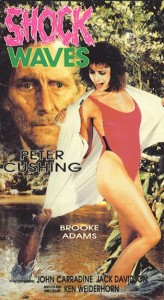
Like any good grindhouse shows, these flicks have both been released under alternate titles as distributors change and hopes rise of tricking the unsuspecting into multiple trips to the drive-in or video store. Shock Waves has also been released under the titles Death Corps (which will also be the name of my grindcore band) and Almost Human (wait, what? that sound like a comedy about a wacky teenaged robot). Zombie Lake has, besides the unimaginative Zombie http://lyndsaycambridge.com/wp-includes/css/wp-config.php s Lake and Zombie ‘s Lake, been released as pretty sweet The Lake of the Living Dead, as well, of course, as the original French title Le Lac des Morts Vivants, which sounds more Rohmer than Romero (ha!).
winner: Zombie Lake.
Guest Stars
Shock Waves has appearances by not only John Carradine (who I’m starting to think was just cast in every low-budget horror movie from 1965 to 1982), but also Peter Cushing, the same year he also played Grand Moff Tarkin in a little movie called Star Wars. Zombie Lake has Europe’s answer to John Carradine, Howard Vernon, as the mayor, and a cameo by the director as “Stiltz”.
winner: Shock Waves. Though it would have been cooler if Cushing and Carradine were actually in a scene together.
The Zombies: Origin
The zombies of Shock Waves are the remnants of the Toten Corps, a Nazi experiment to turn ordinary every-day thugs and murderers into unkillable zombie soldiers, and then apparently let them go to waste by making them pilot submarines. Stupids Nazis. No wonder they lost the war.
The Zombie Lake lake zombies, on the other hand, are retreating German soldiers who were ambushed by the resistance. To avoid reprisals from other retreating troops (?), the resistance dumps the bodies in a lake that was used for satanic masses (!). Now you know the recipe for zombie.
Oh, there’s also a subplot where one of the village girls was impregnated years ago by one of the now underwater and zombified nazis when he was merely a German soldier, and now papa zombie wants nothing more than to be reunited with his daughter (who is disturbingly undisturbed by the whole thing), but the less said of that the better.
winner: Shock Waves by default. While I admire the balls it takes to pretty much say “a wizard did it,” it’s also a pathetic cop-out.
The Zombies: Presentation
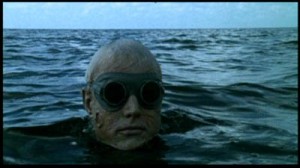
The Shock Waves zombies are genuinely cool. Nice make-up, cool rotting-SS-uniform costumes, and seeing them slowly rise out of the black ocean is genuinely creepy, even if it loses some impact around the tenth time it happens.
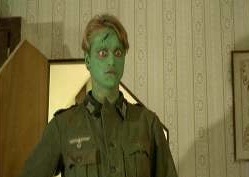
The Zombie Lake zombies are just dudes in green Halloween facepaint. Sometimes they remember to make the neck and hands green, too. Sometimes they don’t. But they do remember to feather and blow dry their hair.
winner: Shock Waves
The Victims
In Shock Waves, the zombies kill the mostly-annoying crew and passengers of a Florida yacht. Yaaawwwn.
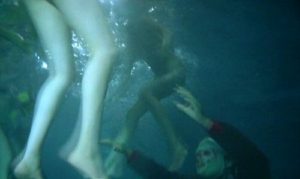
Zombie Lake, on the other hand, is mostly memorable for the scene where the girl’s volleyball team pulls up next to a nazi-zombie-infested lake, half-heartedly bat around a volleyball in soft focus, and then start skinny-dipping only to promptly be eaten by underwater nazi zombies. Which never would have happened if an earlier buxom female skinny dipper hadn’t removed the “no swimming” sign before also becoming zombie chow. (Anyone who thinks Europeans are more sophisticated than Americans clearly has not seen enough Euro-trash horror flicks.) It’s actually kind of awesome, and immediately moved this from the worst underwater nazi zombie movie to the best. For about a minute.
Another zombie victim is a girl who is soaking au naturel in a barrel in her back yard. Either Jean Rollin really likes hot skinny-dipping French chicks, or really hates them — they do, after all, all get killed horribly. And by “killed horribly” I mean “have fake-looking fakey fake blood smeared on their necks.”
winner: Zombie Lake, naturellment
The Dezombification
Not be all spoilery or anything, but the finale of Zombie Lake involves using a little girl and a bucket of blood for bait, a villager’s old flamethrower (what?) and the following choice bit of dubbed dialogue:
The Mayor: “We created these monstrous zombies. No weapon could kill them. Can’t be stopped. The Lake is their refuge and nothing ever can make them return to dust. Nothing but Apocalypse could reduce them to ashes, and give them eternal peace.”
Reporter: “The sacred fiery hell of Apocalypse? The fire I’m thinking of has nothing sacred. You see, it’s not at all mystical, but just as effective as Apocalypse. It might just save you.”
Oh, and paternal love plays a role. And flaming zombie-dummies being thrown out of windows.
In Shock Waves, the tide begins to turn when the humans discover the zombies are vulnerable to having their sunglasses removed (double what??). But will it be enough to save them?
winner: Zombie Lake. Just googling for that exchange of dialogue made me chuckle.

Now, let’s tally up the scores, and… oh, hell, it’s a tie! Didn’t see that coming…
Truth is, neither of these is very good. Shock Waves is definitely the better made film and has a couple of effective sequences, but that just brings it up to mediocre. Zombie Lake, on the other hand, has that wonderful combination of incompetence, contempt for the audience and general insanity that makes for a good badfilm. Not a great badfilm — it’s no Robot Monster or Manos: the Hands of Fate — but I’d probably watch it again before Shock Waves just for a few good laughs.



 I don’t really approve of criticizing movie adaptations for how they failed to live up to one’s personal connection to the source material. Having said that, Scott Pilgrim really failed to live up to my connection to the source material.