Singapore to Istabul 3: routes

If you don’t know where you’re going, you’re going to end up someplace else.
– Yogi Berra

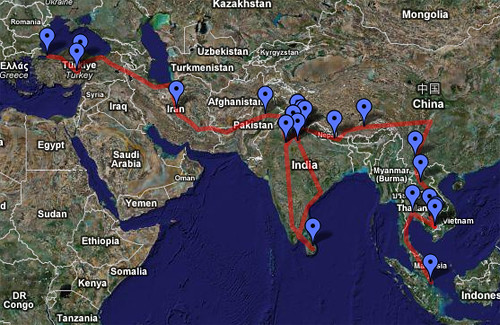
My ambition is to travel over land from Singapore to Istanbul. I don’t really mind ending up somewhere else, but I’ve selected that as a reasonable goal — far beyond anything I’ve done before, but doable. As I’ve mentioned before, I’m not going to plan things out in any detail ahead of time. I expect to buy a one-way ticket to Singapore, pack a bag, and hit the ground running. Assuming that’s allowed in Singapore — it may well be a caning offence, from what I hear. But you take my point.

Technically, I could just leave it at that: figuring out a route and learning about the region as I do it. There’s certainly a pretty strong appeal to doing it that way — the romantic idea of the vagabond world traveller. But part of the reason for thinking about this trip now is to keep myself motivated for the next two years, so I need to allow myself the luxury of fantasizing about it. And this requires the input and distillation of information. Plus, just in general, I like to read and do research and know about things. Why deny my natural kittenish curiosity?


View Larger Map

This is the main route I’m investigating. I’ve used BookMooch to trade some of my old books for a few slightly-outdated (but still informative) Lonely Planets and Rough Guides, so hopefully I’ll be filling the map up with interesting destinations over the next few months. Right now, the route goes through:

  1. Singapore
  2. Malaysia
  3. Thailand
  4. Cambodia
  5. Laos
  6. China (Yunnan)
  7. China (Tibet)
  8. Nepal
  9. India
  10. Sri Lanka (maybe)
  11. Pakistan
  12. Iran
  13. Turkey

I figure I can easily spend an average of a month in each of these places and hit Istanbul a year after I set out. However, I don’t know a huge amount about anything after China (and even China, I’ve only just started reading about). So I have a fair bit of work ahead of me. And then there are alternate routes and side-trips, depending on the political situation in Myanmar and the Middle East. I doubt Afghanistan will be very tourist-friendly when I set out, but Syria might be. Not to mention, China is a very large and diverse country, and there’re trains from there to to Mongolia and Russia…
seriously, Rules of the Game?

even_dwarfs_started_small_s.jpgEdward Copeland has compiled his internet-surveyed list of the top-voted non-English-language films (you can see how I voted here). Kudos to him for doing it — it was no small feat, and a list like this is useful and interesting to a whole lot of people, including myself.
But the list itself left me unsatisfied. Ultimately, it really did turn out to be nothing more than a predictable ranking of The Foreign Classics Canon. Of the Top 25 films, the most recent is Ran from 1984 — and it was made by Akira Kurosawa, already acknowledged at the time as one of the pantheon. And if you know anything about foreign film as it is presented in film studies courses and Sight and Sound surveys, I’m sure you can name the other 24 — especially if I tell you that all but one or two were made by Great Auteurs. Cahiers du cinéma, you have a lot to answer for.

I guess what disappoints me is that what we really have here is the internet community reinforcing the academy. I mean, the number one film is Rules of the Game, which to my mind is the classic example of the masterpiece that is only judged such due to groupthink (and aided, of course, by the colourful history of the film itself). Don’t get me wrong — it’s a fine and interesting film. But are there actual film buffs out there — actual film fans, I mean, not Film Studies professors and historians — who would in their heart of hearts say it’s their favourite film? Or has the critical (pun intended) mass around the film grown such that it’s just easiest to go with the flow? And I have the same question about a lot of other films on the list. Are there people out there who can watch Contempt and say, “wow, that really speaks to me”? Or do they, like me, struggle to stay awake, admire what Godard accomplished, and quietly resolve not to ever watch it again?

Of course, the problem with these surveys is that the top films don’t actually have to be the favourites of anyone at all. They just has have to place on enough individual lists. Films that are easy to build consensus around will place highly. This will in turn reinforce the consensus on the next list (people love to vote for winners, especially if they think it will make them look smart), and pretty soon you have a canon of nice, safe, uncontroversial films that may well be excellent without particularly speaking to anybody.

I want to see a different kind of list. I want to see an anti-canon. Instead of a poll of 100 films, I want to see a list of a hundred people’s single favourite films that weren’t nominated. I want to see the top 100 films you would never be shown in film school. I want to see the list of peoples’ votes for “respectable” films that should be striken from the canon. I want a list of buried gems. I want to feel that I haven’t seem everything worth seeing, because I know I haven’t. I want a list that stimulates me to think differently and try new movies I wouldn’t ordinarily, movies that fill my withered veins with cinematic blood. Is that so much to ask you people for?

Singapore to Istanbul 2: travel planning and philosophy

trip-snip-2.jpg“Not many people got a code to live by anymore.”

– Bud, Repo Man

Okay, I’m obviously not going to be able to do this while saddled with grad-school debts, so this winter (2007-2008), I’ll be going on leave from UBC to work full-time for a start-up I’ve been associated with since I started my PhD. This is not only going to provide me with a not-unwelcome respite from grad school, but they can pay me something approximating a salary. Given that my lifestyle is decidedly studentish, and I’m not planning to develop any habits more expensive than martinis, second-hand clothes and DVD rental, I expect to be able to save a pretty good chunk of money — enough to travel for a year (probably more, if I want or I’m really thrifty).

And for what it’s worth, I do think it’s important to have enough money. And I’m not talking about a lot of money. Just: enough. I have no desire to travel in insulated luxury in a package tour. That’s boring. But at the same time, you see a lot of backpackers in SEA trying to hold to crazy budgets, living off fruit and pancakes, haggling with the locals over the price of a bag of cookies, and bragging about sneaking into attractions without paying. That’s not the life for me.

I figure once I get back to school after working, I’ll be 12-18 months from finishing my thesis, meaning I should be able to head out in the fall of 2009. A long way off from where I’m sitting now (a Vancouver Starbucks, in the historic year 2007), but it’s nice to have something to look forward to other than school and work.

I’ve made a few vague decisions about how I want to travel. I fully intend to break as many of these as I feel like.

  • I’ll be flying into Singapore and out of Istanbul. All other travel is to be over land and water. (My biggest concern here is the political situation in the middle east circa 2010. We’ll just have to see.)
  • I’m not going to plan the route ahead of time, though I’ll be researching the options. If I find myself in some place cool, I want to be able to stick around for an extra week or a month. If I hear about some place cool from other travellers, I want to be able to take a few days to check it out. (This was a big issue on my last trip to SEA: I was with my friend Janelle in Laos and we would have loved to stay longer, but our schedule dictated we had to get to Hanoi or everything would be screwed up.)
  • I’m seriously considering not taking a camera. It’s great to look at pictures later to remind yourself of what you saw, but it really affects the way I travel, and not for the better. It would be nice to just keep a journal of my impressions. Realistically, though, I think I’ll be packing the camera.
  • I really want to travel light. I made that decision on my previous SEA trip and it was so utterly correct I’m just totally smug about it. I’ll be setting out with a carryon-sized backpack and purchasing what I need as I need it, and discarding it when I don’t. A bag twice as big only makes you slightly better prepared, and it’s way more than twice the inconvenience.
  • While I’m kind of looking forward to travelling by myself for a bit, I’m hoping people will accompany me for most of my trip. I’ve been mentioning the possibility to a few folks. We’ll just have to see what happens between now and 2009/2010.

Canadian Indie-Rock Primer

arcade_snip.jpgDon’t you love it when two awesome things come together? My fave pop-culture web site, The A.V. Club delivers a cool primer — complete with tons of videos — on the Canadian indie music scene, which has just been going from great to Ubergreat for the past few years. It’s a pretty cool introduction to give to your non-Canadian and/or non-indie friends, even they do skip the post-rock stylings of Do Make Say Think and Godspeed You Black Emperor, and the offbeat hip-hop of Buck 65 and Kid Koala.
Once you read and watch all that, you’re gonna have to get your hipster-geek ass over to CBC Radio 3 for the podcasts (I recommend starting with the laid-back cheerleading of the endearingly dorky Grant Lawrence).

Travel Geek: Singapore to Istanbul

Singapore to Istanbul, originally uploaded by Mister Wind-Up Bird

.

I’m not remotely a hard-core traveller. I grew up in Saskatchewan, in a fairly large lower-middle class household (some of my early years were in a trailer in northern Saskatchewan). International travel always seemed like an unattainable, exotic thing. As a family, the Brochus took out-of-province trips to Manitoba and Alberta, and I ventured as far into the States as South Dakota on a high school band trip. I was 24 the first time I boarded a plane, 25 the first time I saw the ocean, and 27 the first time I left North America (to visit Australia).

In the few years since then, of course, things have changed. As a grad student in an area of research that is fairly well-funded, I get to take breaks to travel, sometimes on the department dime. In the past few years, I’ve been to Montreal, Miami, San Diego, Australia (twice), New Zealand, Thailand, Vietnam, Laos and Japan.

Visiting Southeast Asia had always been a dream of mine, and I loved it. Even the parts that sucked were awesome. At the same time, since returning, I’ve been finding the PhD to increasingly be a drag. I’ve spent literally months on papers that have been rejected, other months doing work I had to abandon, and even a few months where I know I worked every day, but I can’t for the life of me figure out what I actually did. Worse yet, my research failed to turn the field of Artificial Intelligence on its ear. Discouraging. (Though I did recently win a graphics research award, despite that not being my field.)

And so, to keep myself motivated, I’ve started planning out my post-graduate backpacking trek across Asia. As I alluded to in my last post, I’m currently working so that when I finish my PhD, I can take an extended break to do it. Right now, my goal is to travel, without flying, from Singapore to Istanbul, over a period of maybe a year. I may change the start and end locations, and the duration, but that’s the dream.

I know what you’re saying: “Eric,” you say, “that’s totally awesome, yet totally such a cliché.” To which I can only say, “yes, it is awesome. Thank-you. And what are you, the cliché police? Shut up.”

And so, because I’m a total geek, I’m going to start blogging about my investigations and plans. For now, I’m just going to keep it as part of the main blog (under the tag singapore to istanbul — I will really need a better name than that), posting maybe once or twice a week, depending on how things go, and how busy I am with other things.

working stiff

morrissey and smiths free zone, originally uploaded by Mister Wind-Up Bird.

I resumed working in Yaletown this past week. Apparently, the Morrissey Mondays I ran on the office sound system on my last stint have been recalled less-than-fondly.

I’ve been associated with this start-up there since I began my PhD, and I was working there full-time this past winter. I’ll be there for a bit of a longer stretch this time, but the timing is ideal: I finished my thesis proposal and several paper this past summer, and Nando, my supervisor, is taking a year-long sabbatical. At the same time, the start-up has doubled in size this past summer, and is in a much better position to be able to give me a proper salary, so that’s pretty cool.

The job is a good way to keep a foot in industry (I’ll be doing Machine Learning research and development, essentially, which is exactly what I want to do post-PhD), but my ulterior motive is to accumulate enough money to take a year and travel across Asia when I finish my PhD. I don’t think this will be too hard if I don’t develop any new habits more expensive than coffee, sushi and DVD rental.

This also means longer hours working and less time looking at You Tube and composing dorky lists of my favourite movies, so we can probably expect the frequency of my blogging to drop off. Sad, I know, but sacrifices must be made.

The Wire: “Fuck the average reader. Fuck him to hell.”

The Wire — confusing, painful, and exhilarating — may well be the very best and smartest show of the current Golden Age of TV serial drama (though I’ve only seen a few episodes of The Sopranos). Kottke has a great roundup of recent links and quotes about the series, including creator David Simon talking about his show:

My standard for verisimilitude is simple and I came to it when I started to write prose narrative: fuck the average reader. I was always told to write for the average reader in my newspaper life. The average reader, as they meant it, was some suburban white subscriber with two-point-whatever kids and three-point-whatever cars and a dog and a cat and lawn furniture. He knows nothing and he needs everything explained to him right away, so that exposition becomes this incredible, story-killing burden. Fuck him. Fuck him to hell.

Aside from the evil clone of Robot Hitler, there is nothing I hate so much as being talked down to, and The Wire — along with Deadwood and Battlestar Galactica — have earned a very special place in my heart by making the radical assumption that a TV viewer like myself might actually be as smart as the writers.

25 Non-English Language Films

sevsamsnip.jpgEdward Copeland has undertaken an ambitious project on his blog: trying to assemble a Top 25 list of non-English language films. Interestingly, he’s running it in two rounds: in the first, an invited group of people submitted their lists, which were whittled down to 123 films. Voting on those 123 films is now open to the public (until September 16, so get those lists in!).

One side-effect of doing it this way is that the list has the feeling of ranking the existing canon of Generally Acknowledged Foreign Masterpieces (yes, that’s the required capitalization), because only films that already had some kind of consensus behind them made it to the second round. This is probably unavoidable, but it does have the effect of pruning idiosyncratic, controversial and/or obscure choices. As much as I may love Even Dwarfs Started Small, there’s not much hope of it making it onto a list like this: it’s an idiosyncratic, controversial and fairly obscure choice. The comments on Edward’s blog have been full of people’s personal top choices of films that didn’t make the list, a lot of which look more interesting to me than all the Bergman, Godard and Fellini films that made it on.

Anyway, without further ado, here is my own (very half-assedly ranked) Top 25 from the 74 films on the list that I’ve seen:

  1. The Seven Samurai directed by Akira Kurosawa
  2. Aguirre, the Wrath of God directed by Werner Herzog
  3. Ikiru directed by Akira Kurosawa
  4. Ran directed by Akira Kurosawa
  5. Spirited Away directed by Hayao Miyazaki
  6. Yi Yi: A One and a Two directed by Edward Yang
  7. Nosferatu the Vampyre directed by Werner Herzog
  8. Wings of Desire directed by Wim Wenders
  9. Chungking Express directed by Wong Kar-Wai
  10. M directed by Fritz Lang
  11. Yojimbo directed by Akira Kurosawa
  12. The Wages of Fear directed by Henri-Georges Clouzot
  13. High and Low directed by Akira Kurosawa
  14. Amelie directed by Jean-Pierre Jeunet
  15. Throne of Blood directed by Akira Kurosawa
  16. Das Boot directed by Wolfgang Petersen
  17. Run Lola Run directed by Tom Tykwer
  18. Le Samourai directed by Jean-Pierre Melville
  19. The Enigma of Kaspar Hauser directed by Werner Herzog
  20. Andrei Rublev directed by Andrei Tarkovsky
  21. Children of Paradise directed by Marcel Carne
  22. City of God directed by Fernando Meirelles and Katia Lund
  23. Three Colors: Blue directed by Krzysztof Kieslowski
  24. Crouching Tiger, Hidden Dragon directed by Ang Lee
  25. The Blue Angel directed by Josef von Sternberg

Of course, it’s very likely that if and when I see the rest (many of which are on my to-see list), this list would change. The ones I haven’t seen are: Ali: Fear Eats the Soul (Rainer Werner Fassbinder); All About My Mother (Pedro Almodovar); Army of Shadows (Jean-Pierre Melville); Ashes and Diamonds (Andrzej Wajda); Au Hasard Balthazar (Robert Bresson); The Bitter Tears of Petra von Kant (Rainer Werner Fassbinder); Celine and Julie Go Boating (Jacques Rivette); The Conformist (Bernardo Bertolucci); Contempt (Jean-Luc Godard); The Cranes Are Flying (Mikheil Kalatozishvili); Day of Wrath (Carl Theodor Dreyer); Dersu Uzala (Akira Kurosawa); The Double Life of Veronique (Krzysztof Kieslowski); The Earrings of Madame De… (Max Ophuls); Exterminating Angel (Luis Bunuel); Eyes Without a Face (Georges Franju); Forbidden Games (René Clément); The Gospel According to St. Matthew (Pier Paolo Pasolini); The Great Silence (Sergio Corbucci); I Vitelloni (Federico Fellini); La Strada (Federico Fellini); Last Year at Marienbad (Alain Resnais); Late Spring (Yasujiro Ozu); L’Eclisse (Michelangelo Antonioni); The Leopard (Luchino Visconti); Lola Montes (Max Ophuls); The Marriage of Maria Braun (Rainer Werner Fassbinder); Masculin-Feminin (Jean-Luc Godard); My Night at Maud’s (Eric Rohmer); Ordet (Carl Theodor Dreyer); Orpheus (Jean Cocteau); Pickpocket (Robert Bresson); Pierrot le fou (Jean-Luc Godard); Playtime (Jacques Tati); The Red Desert (Michelangelo Antonioni); Rocco and His Brothers (Luchino Visconti); Satantango (Béla Tarr); Scenes from a Marriage (Ingmar Bergman); Seven Beauties (Lina Wertmuller); Shoot the Piano Player (Francois Truffaut); Smiles of a Summer Night (Ingmar Bergman); Stolen Kisses (Francois Truffaut); Story of the Late Chrysanthemums (Kenji Mizoguchi); Talk to Her (Pedro Almodovar); The Tin Drum (Volker Schlöndorff); Tokyo Story (Yasujiro Ozu); Ugetsu monogatari (Kenji Mizoguchi); Umberto D (Vittorio de Sica); Viridiana (Luis Bunuel); Woman in the Dunes (Hiroshi Teshigahara.

And for the record, some movies that would be in my own Top 25 if they had been on the lost of nominees: Even Dwarfs Started Small (Werner Herzog); Hard Boiled (John Woo); Legend of Drunken Master (Chia-Liang Liu); Stalker (Andrei Tarkovsky); El Topo (Alejandro Jodorowsky); The Holy Mountain (Alejandro Jodorowsky); The Killer (John Woo) and Spring Summer Fall Winter… and Spring (Kim Ki-Duk).